GALAXIES
Fireworks Galaxy (NGC 6946)
— NGC 6946 · Caldwell 12 · Arp 29 —
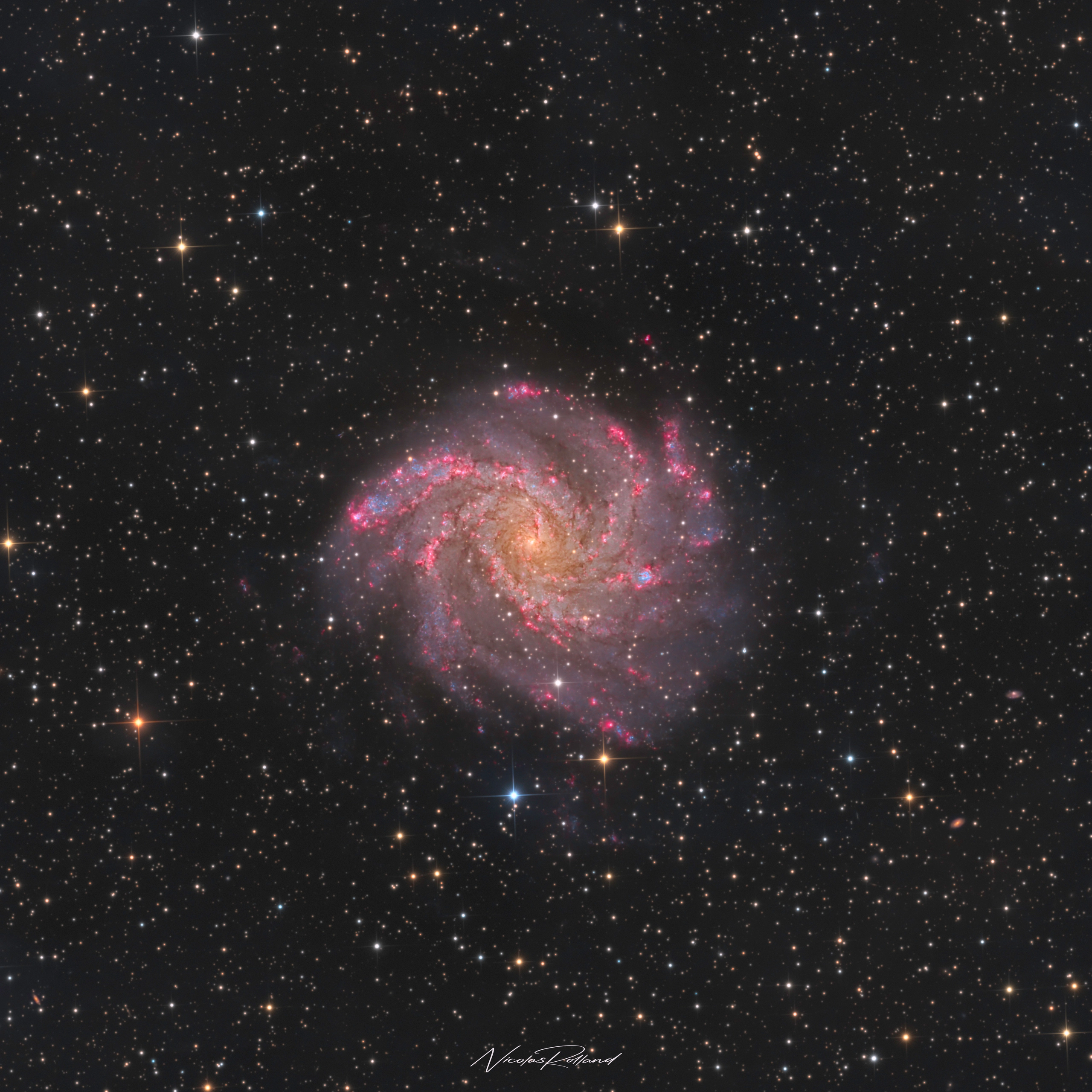
Processed by Nicolas Rolland, Paris. 9.7 hours gathered by Roboscope at Apollo 11 Observatory, Fregenal de la Sierra, Spain.
The pink knots strung along these arms are clouds of hydrogen lit from inside by young, massive stars. Each one marks a place where the galaxy is forming stars now, and there are hundreds of them in this frame.
Ten supernovae in a century
Since 1917, ten supernovae have been recorded in NGC 6946, from SN 1917A to SN 2017eaw. That count is where the name comes from. The Milky Way, by comparison, is thought to produce one or two per century, and none has been seen in it since 1604. The cause is the same as for the pink knots: the galaxy forms stars quickly, and the most massive of them live only a few million years before their cores collapse. SN 2017eaw had faded long before these frames were taken, and no supernova is visible in this image.
A galaxy that shows its star formation
Most spirals keep their star-forming regions in thin arms that are hard to follow at this distance. NGC 6946 is close enough, open enough to our line of sight and active enough for them to appear in a single frame, spread across the whole disc rather than confined to its centre. It is one of the galaxies supernova searches return to most often, for the reason given above. The colours here are close to natural but not entirely: the red, green and blue layers give the stars and the disc their broadband colour, and the hydrogen-alpha signal is blended into the red channel, which makes the star-forming regions stand out more strongly than broadband filters alone would show them.
The chain, and what it allowed
The data comes from a Planewave CDK17 at f/6.8 with an FLI Kepler 4040 camera, at the Apollo 11 Observatory in Extremadura — 432 mm of aperture sampling at 0.314 arcseconds per pixel. The collect gave 29.2 hours in August 2024, and the largest share did not go to luminance: 10.6 hours went to hydrogen-alpha through a 3 nm filter, the layer that carries the pink regions, against 7.7 hours of luminance. That split allowed the inner galaxy in detail — the arms, the dust lanes between them, the regions strung along them. It did not allow the outer disc: where the arms thin out, already dimmed by the Milky Way's dust, is where this image stops. The processing worked inside that limit, blending the hydrogen-alpha into the red. The frames were gathered by Roboscope at the Apollo 11 Observatory, Fregenal de la Sierra, Spain.