GALAXY
The String of Pearls Galaxy
— NGC 55 —
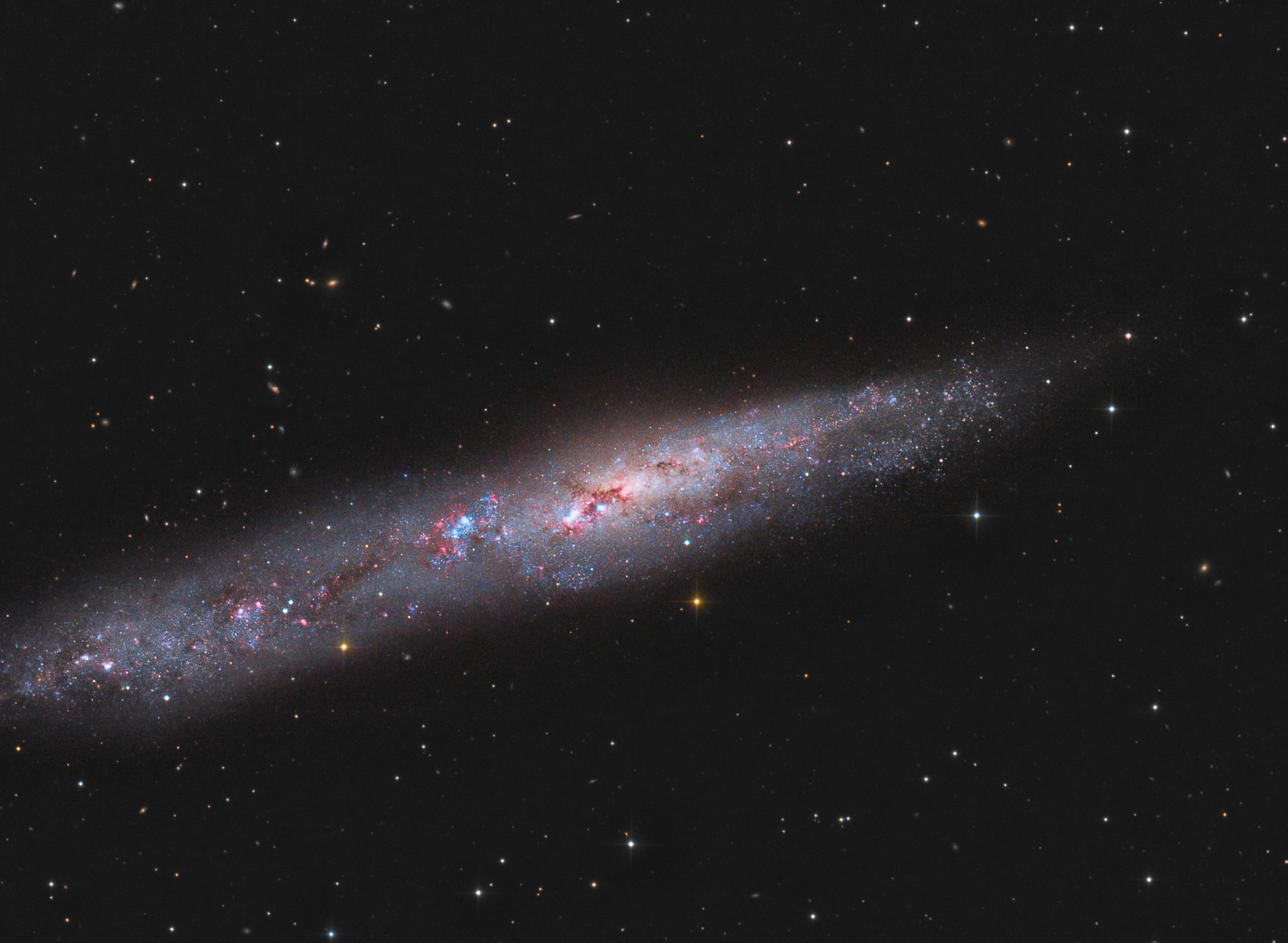
Processed by Nicolas Rolland, Paris. 1.1 hours gathered at El Sauce Observatory, Rio Hurtado, Chile.
This is the same kind of galaxy as the Large Magellanic Cloud, seen from the side instead of from above.
Five point eight million light-years, edge-on
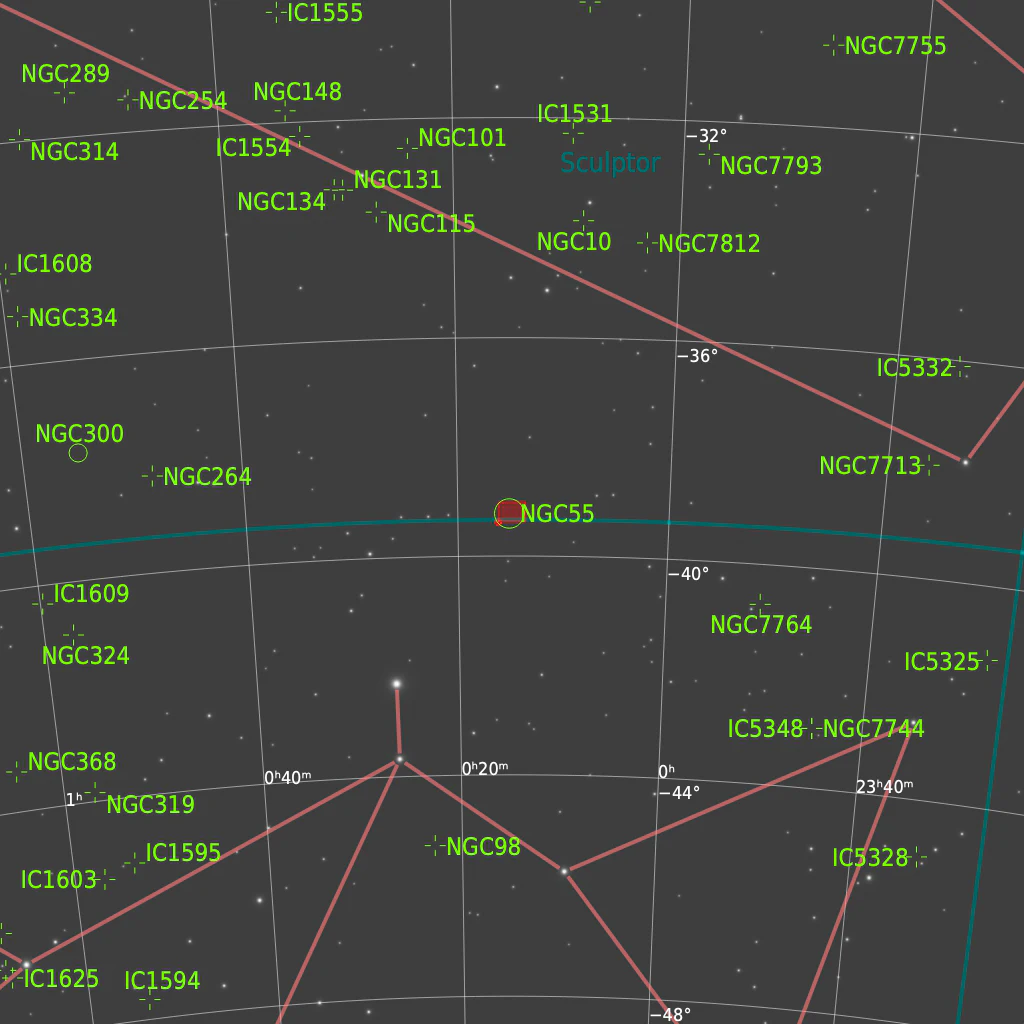
NGC 55 lies in Sculptor, about 5.8 million light-years away, and measures some 60,000 light-years across. James Dunlop recorded it from Parramatta in 1826. It is classified as a Magellanic barred spiral — the class the Large and Small Magellanic Clouds belong to — and we see it almost exactly along its own plane, which is why it reads as a bar of light rather than a disc.
A bar that is not in the middle
Galaxies of this class have a feature that separates them from ordinary barred spirals: the bar does not sit at the centre. The brightest concentration of stars is offset to one side, the arms are asymmetric or barely present, and nothing about the structure is symmetrical the way a grand-design spiral is. The Large Magellanic Cloud shows the same thing, and we see it face-on. Between the two, the same kind of galaxy is available from two angles — which is most of the reason anyone studies this one.
In front of the group it was assigned to
NGC 55 has a companion, NGC 300, and the two form a gravitationally bound pair. Both were long listed as members of the Sculptor Group, the loose collection of galaxies filling this part of the sky. Distance measurements have since separated them from it: the pair sits in the foreground, between us and the group, closer than the galaxies it was catalogued alongside. Membership of a group is not something an image can settle — it takes a distance for each galaxy, measured independently, and the answer changed when those became good enough.
Sixty-five minutes
A Planewave CDK24 at f/6.5 with an FLI ProLine PL9000, from Rio Hurtado in September 2020 — thirteen frames of five minutes each, across luminance, red, green and blue. Sixty-five minutes in total, which is the shortest dataset on this site by some way. At magnitude 7.8 the galaxy itself comes through easily: the bar, the dust, the brightest knots of star formation along it are all bright enough that an hour is enough. Everything else is not. A galaxy this close has a faint outer disc and a halo that go on well past what the bright body shows, and reaching them is a matter of tens of hours. What this frame holds is the part that does not need them.