A Crowded Cluster in Puppis
— NGC 2477 —
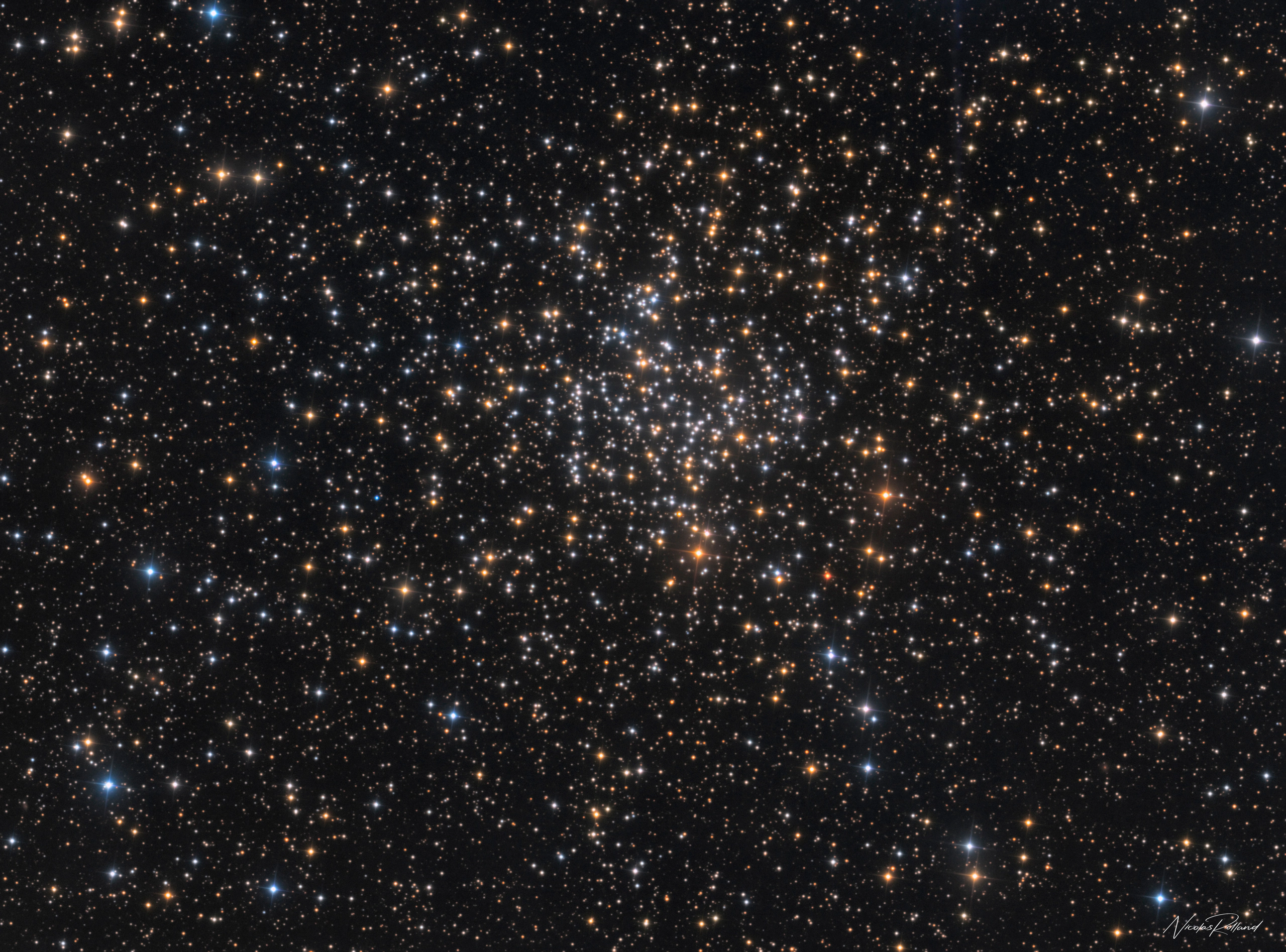
Processed by Nicolas Rolland, Paris. 4.5 hours gathered by Martin Pugh at El Sauce Observatory, Rio Hurtado, Chile.
Lacaille catalogued this as a nebula with no stars in it. He was looking at nineteen hundred of them.
Filed among the starless nebulae
Nicolas Louis de Lacaille recorded NGC 2477 from the Cape in 1751 and placed it among the nebulae without stars — the ones that showed as a haze and refused to break up under his telescope. The haze was the cluster. Through the half-inch refractor he used for that survey, nineteen hundred stars crowded into half a degree return exactly that: a pale smudge with nothing resolvable inside it.
Nineteen hundred stars, thirty-seven light-years
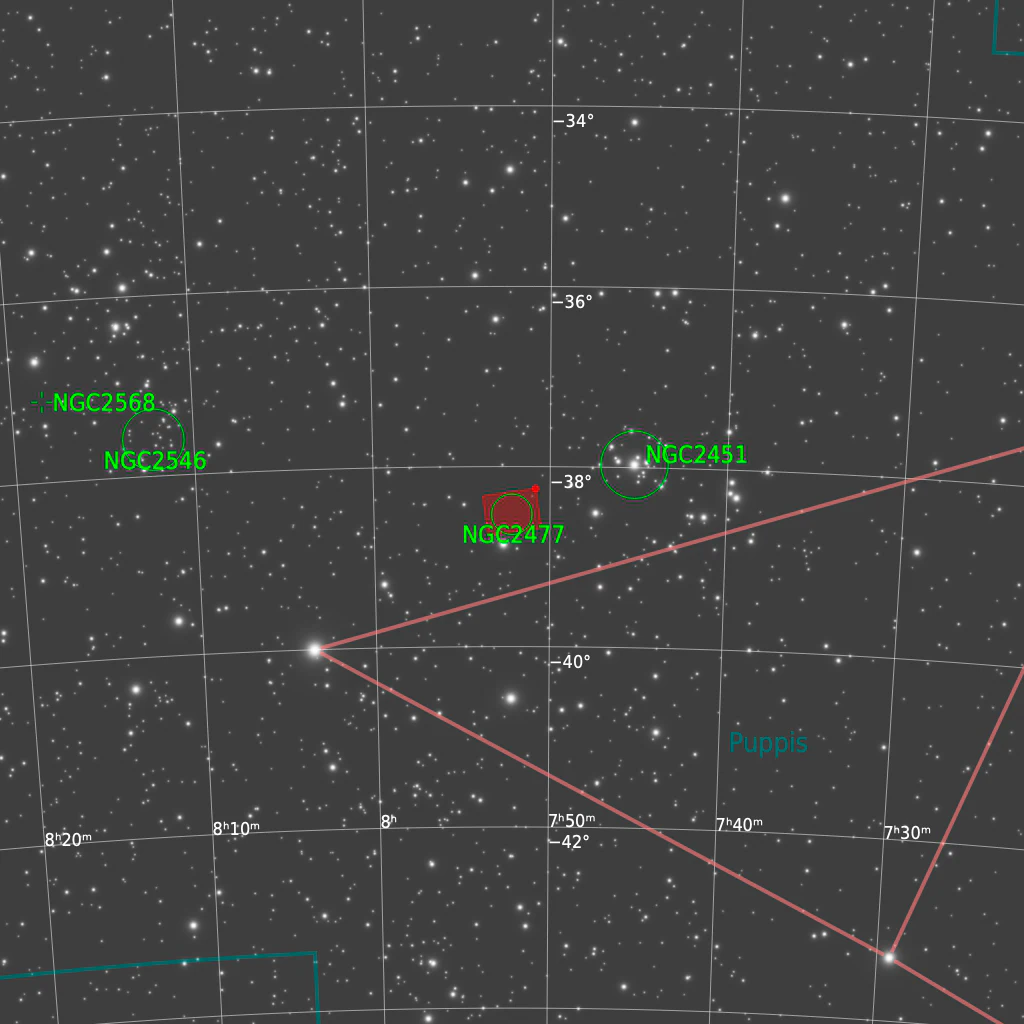
The cluster lies about 3,000 light-years away in Puppis and spans some 37 light-years. On the sky it covers a little over half a degree, close to the width of the full Moon, at magnitude 5.8 — bright enough to be picked up without a telescope from a dark southern site, and dense enough that a small instrument still struggles to separate its members.
A billion years, and still holding
Its age is the unusual part. Open clusters are loosely bound, and most come apart within a few hundred million years, their stars drawn away one at a time by passing clouds and by the pull of the galactic disc. NGC 2477 has been losing members that way for a billion years and still holds nineteen hundred. Age has taken the blue out of it as well: the heaviest stars burned through their fuel long ago, and the brightest members left are yellow and orange giants, which is why the cluster reads warm rather than white.
Four and a half hours, and no luminance
A CDK17 at f/6.8 with adaptive optics ahead of the sensor, from Rio Hurtado in March 2022. Four and a half hours in ten-minute frames, split evenly across red, green and blue — and no luminance frame at all. At magnitude 5.8 there is nothing faint here to reach, and luminance would have added depth the subject has no use for while diluting what it does need, which is the colour separation between the surviving giants and the fainter stars around them. The real limit is not exposure but resolution: towards the centre the members sit a few arcseconds apart, and whether they stay countable depends on how steadily the image is held between guide corrections. Martin Pugh gathered the data at El Sauce.