NEBULAE
Heart Nebula
(IC 1805)
— IC 1805 · Sh2-190 · W4 — Cassiopeia —
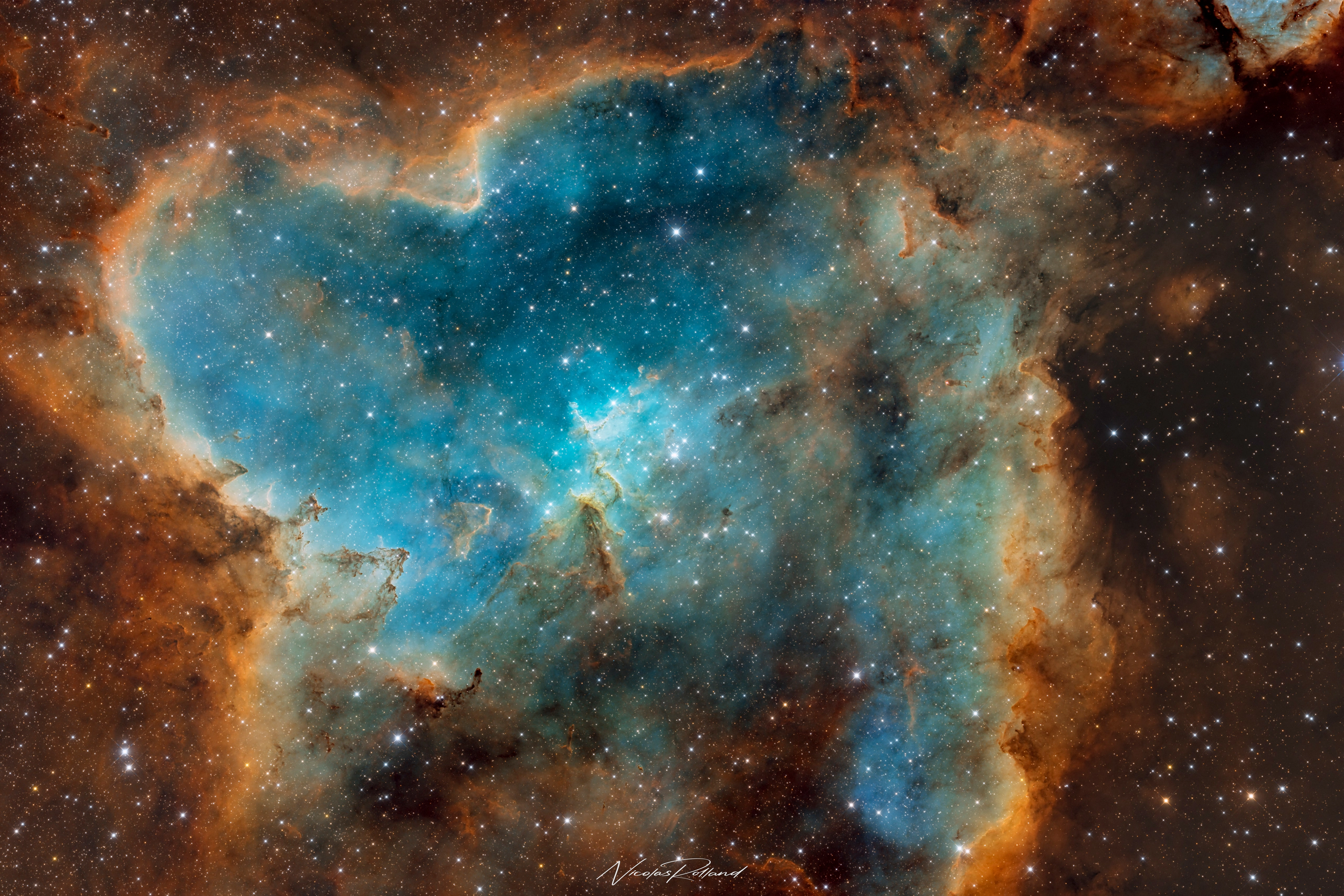
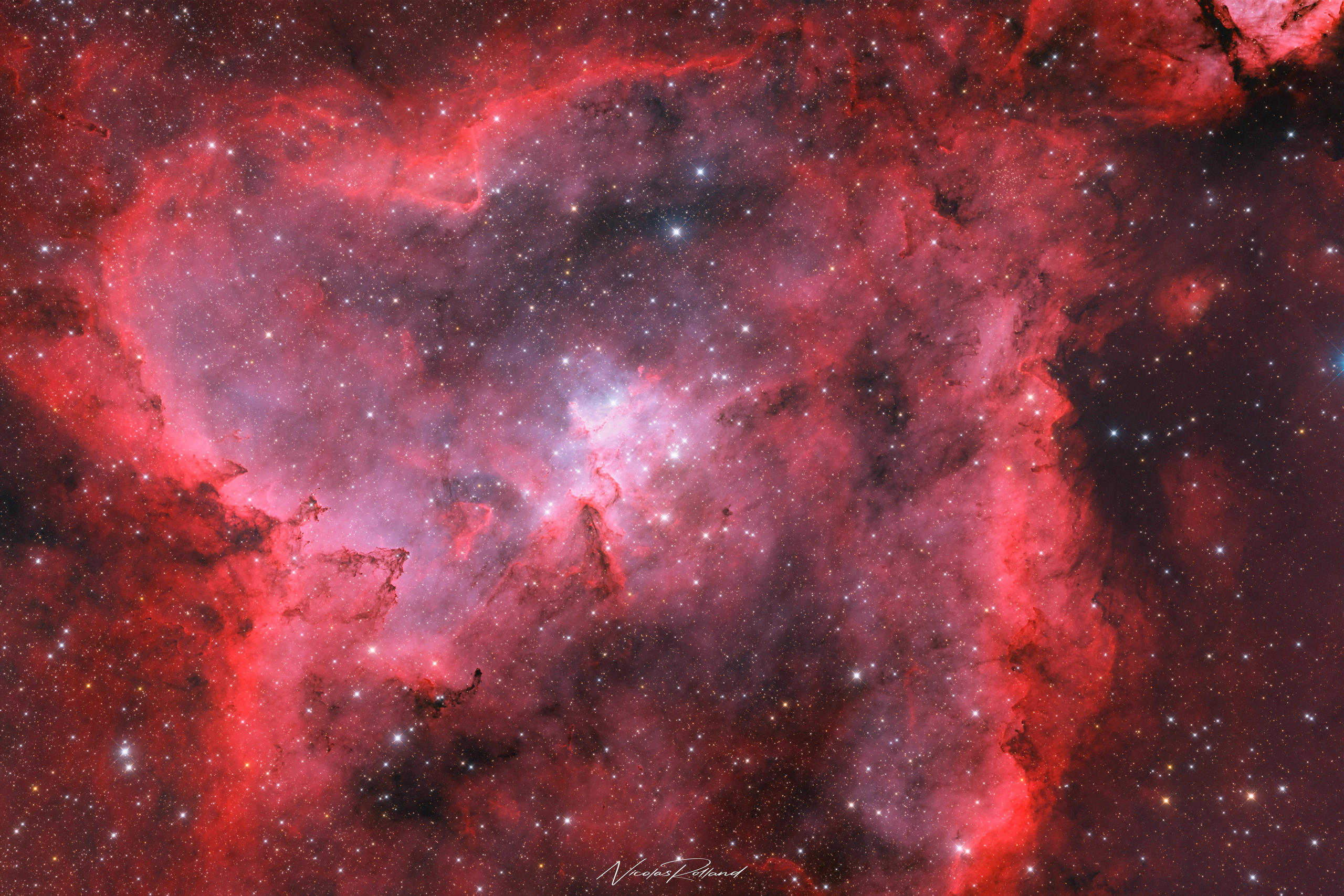
Processed by Nicolas Rolland, Paris. 25.5 hours in SHORGB and 18.2 hours in HOORGB gathered by Roboscope at Apollo 11 Observatory, Fregenal de la Sierra, Spain.
The bright hollow at the centre of this field is not a gap in the nebula. It was carved from the inside, and the stars that carved it are still sitting in it.
A cavity two hundred light-years across
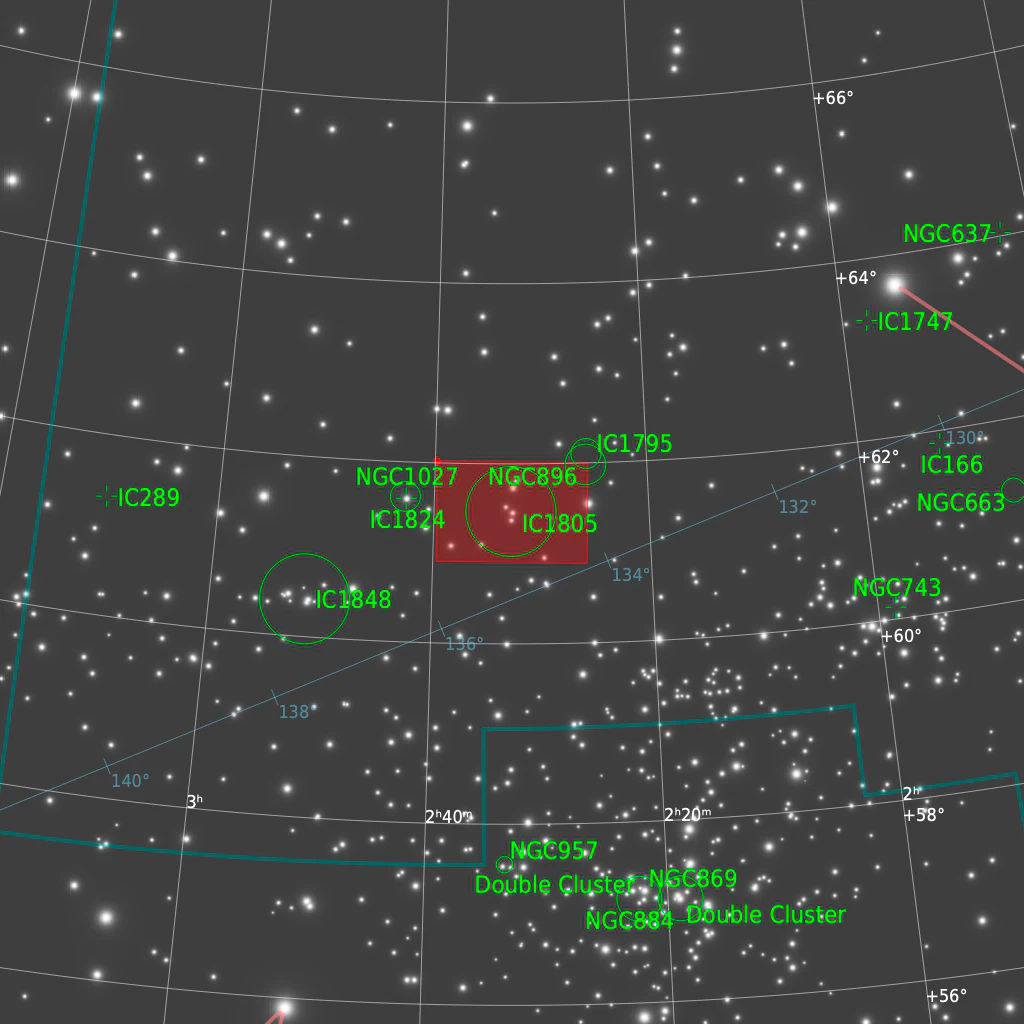
IC 1805 spans about two and a half degrees of sky, which is more than this frame holds. What is shown here is its centre — one and a half degrees on a side, the cavity and the walls immediately around it. The whole complex lies roughly seven thousand light-years away in the Perseus Arm, in Cassiopeia, and belongs to the Cas OB6 association along with the Soul Nebula and the Fishhead.
The open cluster at the middle of the frame is Melotte 15, also catalogued as Collinder 26. It is not a foreground object: it formed here, out of this gas, and it is the reason the region glows at all.
Nine O stars and what they do to a cloud
Melotte 15 contains nine known O-type stars, the hottest and shortest-lived class there is. Their combined ultraviolet output ionises the hydrogen around them, and their winds push it outward. The result is visible directly: a low-density cavity in the centre, gas piled up at its edges, and a set of pillars along the walls whose tips point back toward the cluster. Each of those pillars is a clump dense enough to have resisted the wind while the material behind it was swept away.
The massive stars here are around three and a half million years old. That is young enough that the cloud they formed from has not dispersed, and old enough that the erosion has become the dominant feature of the field.
Why the centre is worth framing alone
Most images of IC 1805 show the whole shape, because the shape is what gives the object its name. At this scale the heart disappears and the mechanism replaces it — the wall, the cavity, the pillars, and the cluster that produced all three. It stops being a silhouette and becomes a record of what a few dozen massive stars do to the cloud they came from.
The colours are assigned, not real. This is a Hubble-palette rendering: sulphur on red, hydrogen on green, oxygen on blue, with the star colours taken from the RGB frames. The blue filling the cavity is doubly ionised oxygen, and it is the faintest of the three narrowband signals in this object.
The chain, and what it allowed
The data comes from a 14-inch truss Newtonian at f/3.6 with a Player One Zeus-455M, at the Apollo 11 Observatory in Extremadura. At that focal length the 3.76-micron pixels sample at about 0.6 arcseconds, coarser than the sky there usually gives, which is why the frames were drizzled at two and the final image sits near 0.32 arcseconds per pixel. The run gave 25.5 hours in September 2024, and the distribution says what the subject was: 7.7 hours went to oxygen, 30 percent of the total and more than hydrogen received. That is the inverse of what the object looks like in a short exposure, where hydrogen swamps everything. Even so, the oxygen set the ceiling — the blue in this image is what 7.7 hours held, and the faintest oxygen toward the edges of the frame sits at the noise floor rather than resolved. The remaining 5.7 hours of red, green and blue carry the star colours and nothing else. Processing worked inside that, separating three emission lines that overlap almost everywhere in the field. The data was gathered by Roboscope at the Apollo 11 Observatory, Fregenal de la Sierra, Spain.