NEBULAE
Superbubble in the LMC
— Henize 70 —
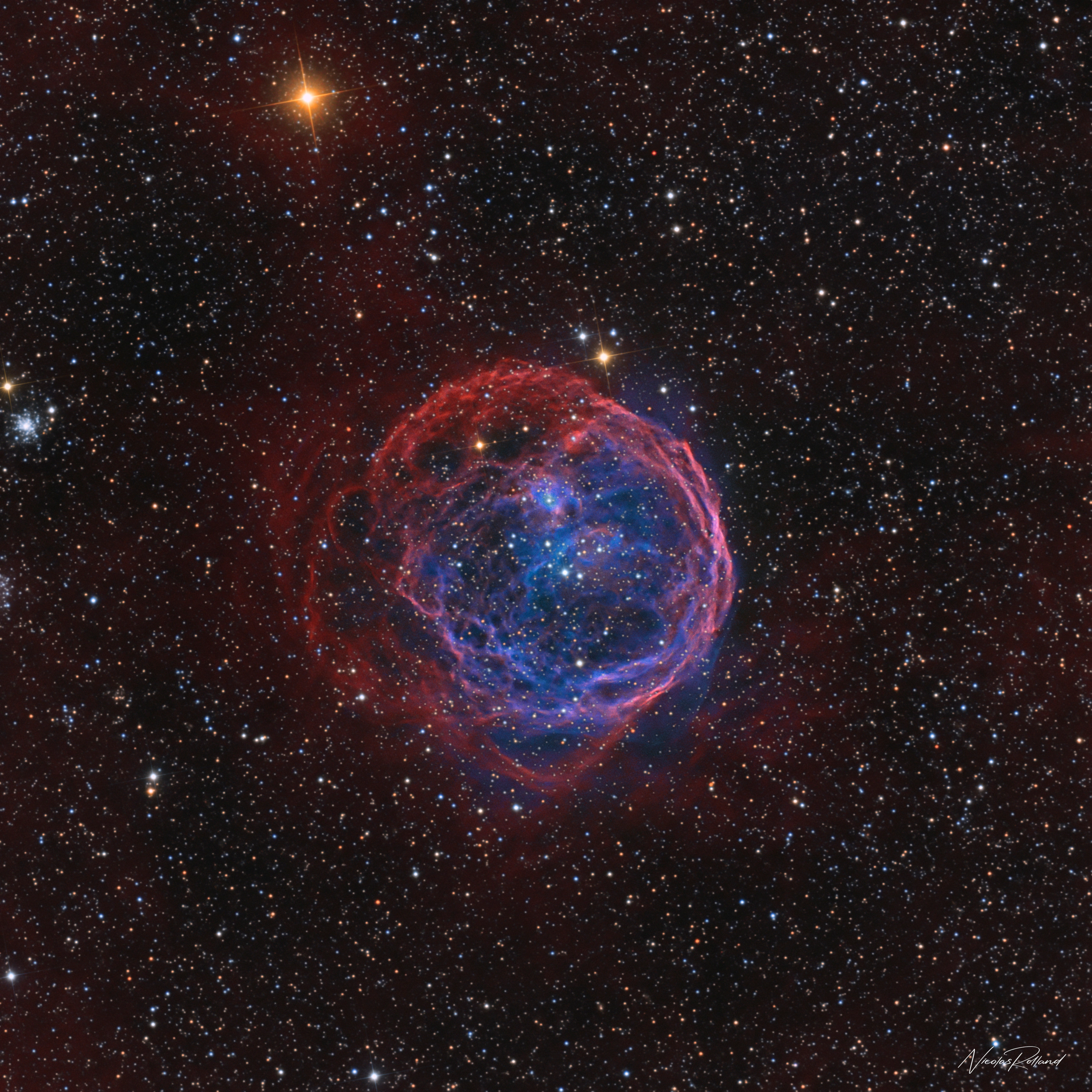
Processed by Nicolas Rolland, Paris. 28 hours gathered by Martin Pugh at El Sauce Observatory, Rio Hurtado, Chile.
This bubble is three hundred light-years across and it is mostly empty. What the image shows is its wall.
Blown from the inside
Henize 70, also catalogued N70, is a superbubble in the Large Magellanic Cloud, some 170,000 light-years away and around 300 light-years across. A small group of very hot O and B stars sits at its centre, and their combined stellar winds have pushed the surrounding gas outward into a shell. There is evidence that an old supernova contributed to the shape as well, though that has not been confirmed.
Several million degrees, and invisible
A superbubble is not a cloud but a cavity. The gas inside it has been heated to several million degrees by the winds and explosions of stars above eight solar masses — hot enough that it radiates in X-rays and gives off almost nothing at visible wavelengths. Everything in this image is the wall: the swept-up material at the edge of the cavity, compressed and lit from within.
Hydrogen on the rim, oxygen in the middle
The H-alpha emission is strong across the shell, which is consistent with a supernova having passed through it. The OIII is intense too, and it sits in the central region rather than at the rim — the blue-green part of this image. That distribution is the useful thing: the two lines are not tracing the same gas, and where each one is strongest says something about what heated it.
Twenty-eight hours, twenty-two of them narrowband
The CDK17 was working at f/6.8 with adaptive optics ahead of the sensor, from Rio Hurtado in February 2022. Of twenty-eight hours, eleven and a half went to H-alpha and ten and a half to OIII — almost an even split, which is unusual. On most emission nebulae OIII is the weaker line by a wide margin and gets a fraction of the time; here it is strong enough in the interior to be worth as much as the hydrogen. The remaining six hours across luminance and colour do one job: they give the surrounding stars their real colours, which narrowband cannot. What none of it reaches is the inside of the bubble, which is where the energy is. Martin Pugh gathered the data at El Sauce.
Henize 70, également cataloguée N70, est une super-bulle du Grand Nuage de Magellan, à quelque 170 000 années-lumière, et large d'environ 300 années-lumière. Un petit groupe d'étoiles très chaudes, de types O et B, se tient en son centre, et leurs vents stellaires combinés ont repoussé le gaz environnant vers l'extérieur pour former une coquille. Plusieurs indices suggèrent qu'une ancienne supernova a également contribué à cette forme, sans que ce soit confirmé.
Une super-bulle n'est pas un nuage mais une cavité. Le gaz qu'elle contient a été porté à plusieurs millions de degrés par les vents et les explosions d'étoiles de plus de huit masses solaires — assez chaud pour rayonner en X et ne presque rien émettre en lumière visible. Tout ce qui apparaît sur cette image est la paroi : la matière balayée au bord de la cavité, comprimée et éclairée par l'intérieur.
L'émission H-alpha est intense sur toute la coquille, ce qui s'accorde avec le passage d'une supernova. L'OIII est intense également, mais il occupe la région centrale plutôt que le bord — la partie bleu-vert de cette image. Cette répartition est ce qu'il y a d'utile : les deux raies ne tracent pas le même gaz, et l'endroit où chacune domine dit quelque chose de ce qui l'a chauffée.
Le CDK17 travaillait à f/6,8, avec une optique adaptative devant le capteur, depuis Rio Hurtado en février 2022. Sur vingt-huit heures, onze et demie sont allées au H-alpha et dix et demie à l'OIII — un partage presque égal, ce qui est inhabituel. Sur la plupart des nébuleuses en émission, l'OIII est de loin la raie la plus faible et reçoit une fraction du temps ; ici, elle est assez présente dans la région intérieure pour valoir autant que l'hydrogène. Les six heures restantes, en luminance et en couleur, ne servent qu'à une chose : donner leurs vraies couleurs aux étoiles du champ, ce que la bande étroite ne sait pas faire. Ce que rien de tout cela n'atteint, c'est l'intérieur de la bulle, là où se trouve l'énergie. Martin Pugh a rassemblé les données à El Sauce.
Palette HOO : le H-alpha occupe le canal rouge, l'OIII les canaux vert et bleu. Les couleurs de la nébuleuse ne sont pas ses vraies couleurs ; celles des étoiles le sont, prises sur les poses à large bande.