NEBULAE
Eskimo Nebula
— NGC 2392 —
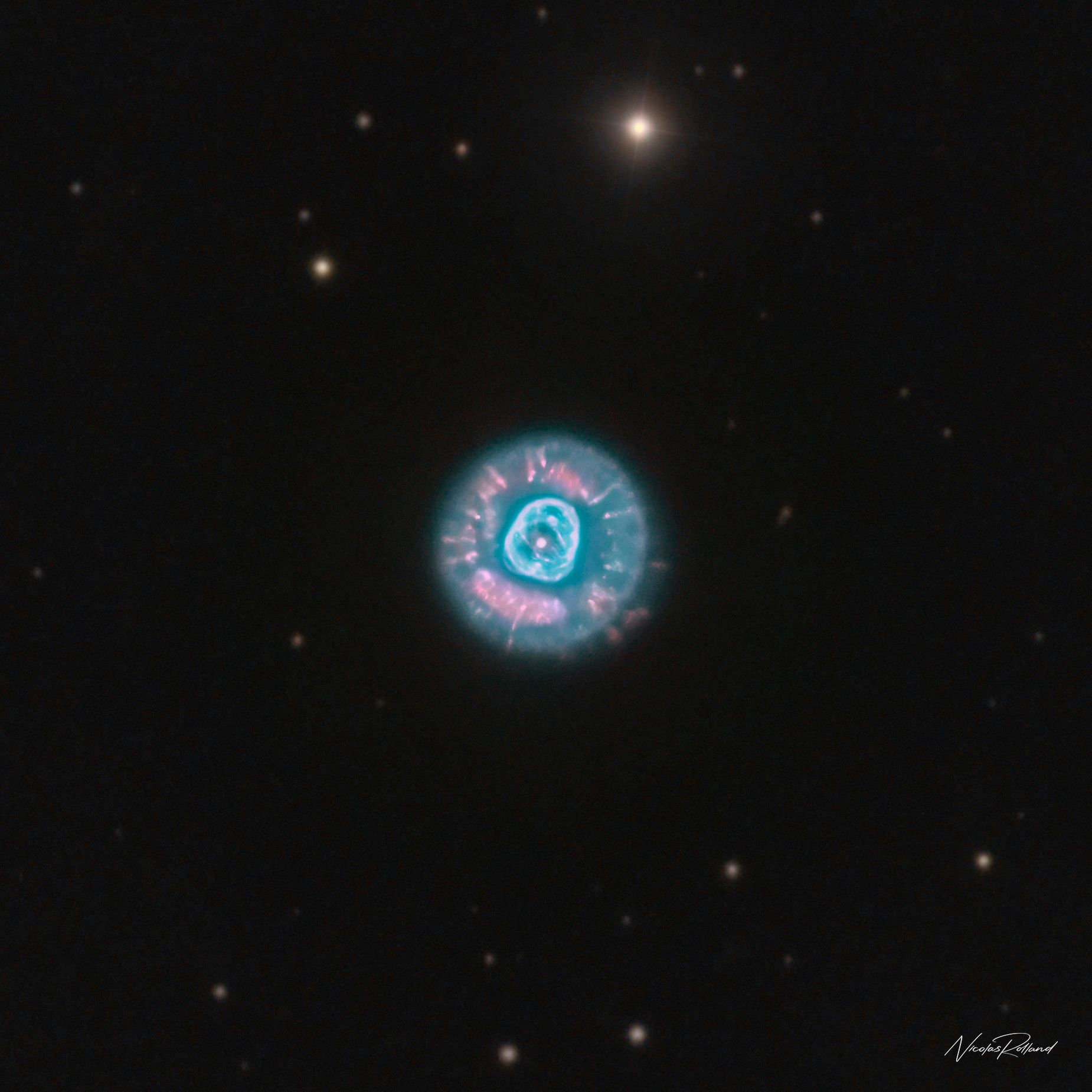
Processed by Nicolas Rolland, Paris. 8 hours gathered at El Sauce Observatory, Rio Hurtado, Chile.
Everything in this nebula fits inside 54 arcseconds. Two shells, a ring of filaments, and a row of comet-shaped knots, all of it under a minute of arc.
Two shells, ten thousand years apart from nothing
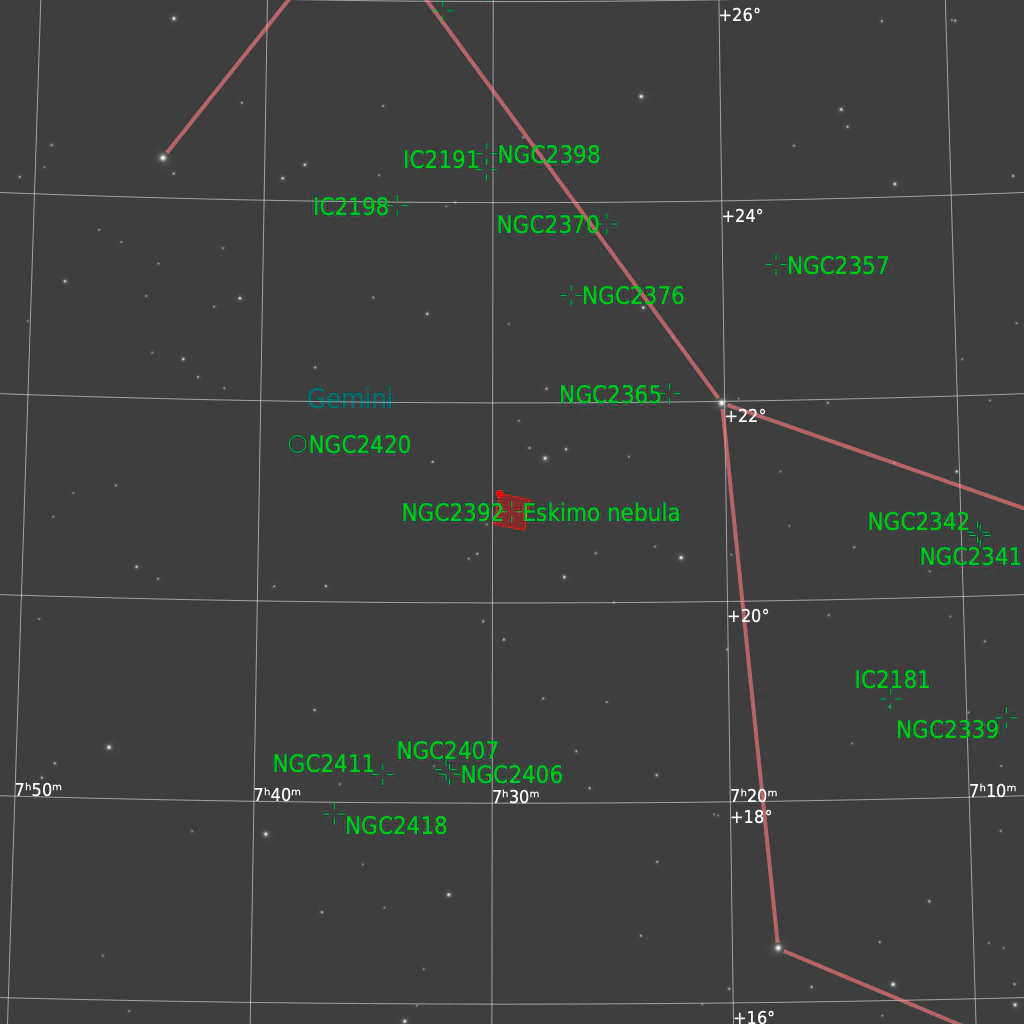
NGC 2392 is a planetary nebula in Gemini, close to δ Geminorum, about 6,500 light-years away. William Herschel found it in 1787. What it holds is the outer atmosphere of a dying star, shed and then lit from within: the star at the centre is now hot enough to be classed O-type, and its ultraviolet is what makes the gas glow. The whole structure is around ten thousand years old, which for a nebula of this kind is middle-aged — old enough to have two distinct shells, young enough that neither has dispersed.
The knots in the outer shell
The outer shell is not smooth. It carries a ring of dense knots, each drawn out into a tail pointing away from the star — the same shape a comet takes, and for a related reason: a fast wind from the central star is streaming past clumps of denser material and eroding them from the front. Each of these knots is roughly a light-year long. They mark where the shell is coming apart, and they are the part of the nebula that changes fastest.
Fifty-four arcseconds
All of that is contained in an apparent width of 0.90 arcminutes. At 6,500 light-years the nebula measures a little under two light-years across, and on the sky it covers less than a sixtieth of a degree — a field this frame gives eighteen arcminutes to. Nothing about a planetary nebula this small is a question of how faint it is; at magnitude 9.1 it is not faint. It is a question of how much detail survives inside a target smaller than the seeing disc on a poor night.
Six hours at 24 inches, two hours at a metre
The colour came from a Planewave CDK24 at f/6.5 with an FLI ProLine PL9000, at El Sauce between November 2021 and January 2022 — six hours across H-alpha, OIII and SII in ten-minute frames. That set the palette and left the core softer than the subject deserved. The luminance came from a second instrument at the same site: an ASA RC-1000AZ, a one-metre telescope, for two hours of H-alpha in five-minute frames. Two hours on a metre of aperture resolved what six hours on 24 inches could not — the filaments in the inner lobe and the cometary knots on the outer shell. On a target 54 arcseconds wide the limit is resolution, and resolution does not accumulate: more hours on the smaller telescope would have produced a cleaner version of the same soft core.
The comparison below is a single frame from each telescope: 300 seconds in H-alpha with the ASA RC-1000AZ, and 600 seconds in H-alpha with the Planewave CDK24.

Comparison between ASA RC-1000AZ (1*300s Ha filter) and PLANEWAVE CDK24 (1*600s Ha filter)