NEBULAE
Supernova Remnant CTA 1 & NGC 40
— SNR 119.5+10.2 · Caldwell 2 —
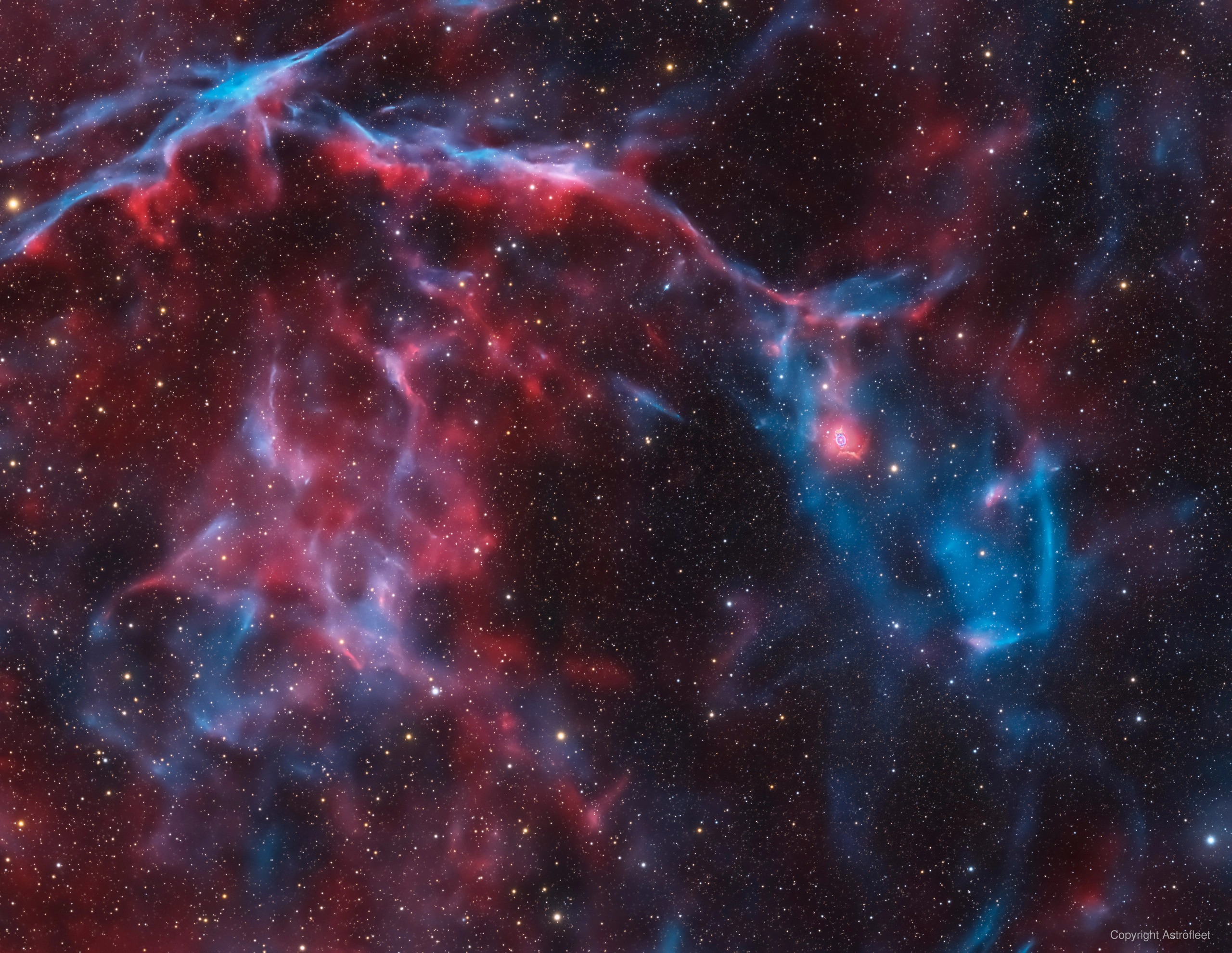
Processed by Nicolas Rolland, Paris, as part of the Astrofleet Team. 60.3 hours gathered with our own setup at PixelSkies, Castilléjar, Spain.
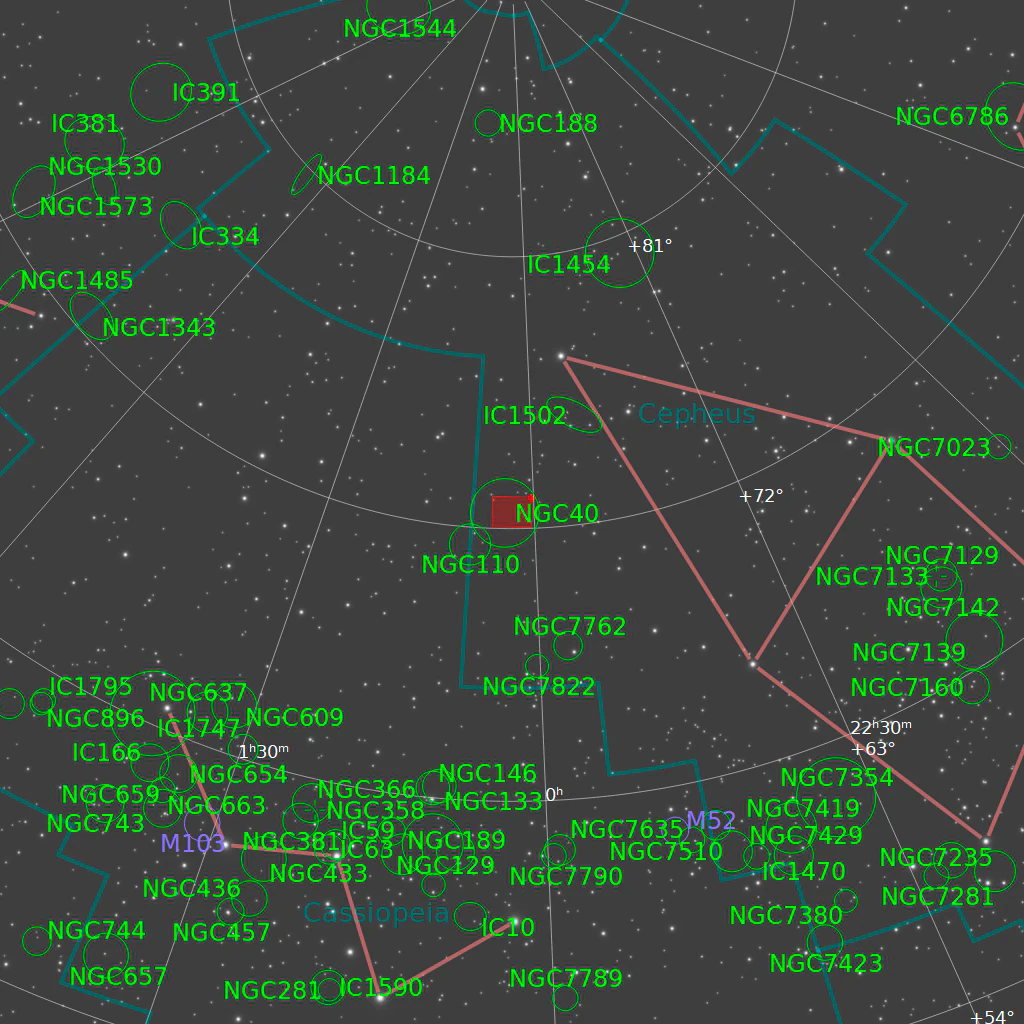
Two nebulae occupy this frame and they have nothing to do with each other. NGC 40 is small, bright and 4,500 years old. CTA-1 is enormous, barely there, and about 10,000. They lie a thousand light-years apart along the same line of sight, and the smaller one appears to sit inside the larger for no better reason than perspective.
A planetary nebula that looks like it belongs
NGC 40, also cataloged as Caldwell 2, is about 3,500 light-years away. At its centre is a white dwarf of roughly 0.7 solar masses — the exposed core of a star that shed its outer layers and now lights them from within. It is compact, well defined and bright enough to be the easy target in this field.
A supernova remnant you have to work for
The faint structures spreading across the rest of the frame are CTA 1, catalogued as SNR 119.5+10.2 — the shell left by a star that exploded roughly 10,000 years ago, at a distance estimated around 4,600 light-years. What survives of it is a network of filaments, thin and low in surface brightness, still expanding into the interstellar medium. Nothing about it is obvious: it is the kind of object that either appears with enough integration or does not appear at all.
Two objects, two processing passes
Processing this image was challenging. Our goal was to maximise the visibility of CTA 1's filaments, which required long hours of exposure. NGC 40, on the other hand, was processed differently, with shorter exposures to protect its core from burning out. The colours are assigned, not real: this is a bicolour HOO rendering, with Ha on red, OIII on blue, and a blend of OIII and Ha carrying the green channel. A narrowband filter records a single emission line, so what it captures has no natural colour until one is given to it. Red marks where hydrogen dominates, blue where oxygen does, and green carries the overlap between them.
NGC 40, également cataloguée Caldwell 2, se situe à environ 3 500 années-lumière. En son centre se trouve une naine blanche d'environ 0,7 masse solaire — le cœur mis à nu d'une étoile qui a expulsé ses couches externes et les éclaire désormais de l'intérieur. Elle est compacte, bien dessinée, et assez brillante pour être la cible facile de ce champ.
Les structures ténues qui se déploient sur le reste du cadre sont CTA 1, cataloguée SNR 119.5+10.2 — la coquille laissée par une étoile qui a explosé il y a quelque 10 000 ans, à une distance estimée autour de 4 600 années-lumière. Il en subsiste un réseau de filaments, minces et de très faible brillance de surface, encore en expansion dans le milieu interstellaire. Rien n'y est évident : c'est le genre d'objet qui apparaît avec assez d'intégration, ou qui n'apparaît pas du tout.
Le traitement de cette image a été un défi. Notre objectif était de maximiser la visibilité des filaments de CTA 1, ce qui a demandé de longues heures de pose. NGC 40, à l'inverse, a été traitée séparément, avec des poses plus courtes pour préserver son noyau de la saturation. Les couleurs sont attribuées et non réelles : il s'agit d'un rendu bicolore HOO, le Ha sur le rouge, le OIII sur le bleu, et un mélange de OIII et de Ha portant le canal vert. Un filtre à bande étroite n'enregistre qu'une seule raie d'émission : ce qu'il capte n'a aucune couleur propre tant qu'on ne lui en assigne pas une. Le rouge dit où l'hydrogène domine, le bleu où l'oxygène domine, et le vert porte le recouvrement des deux.