GALAXIES

The Spanish Dancer

— NGC 1566 —
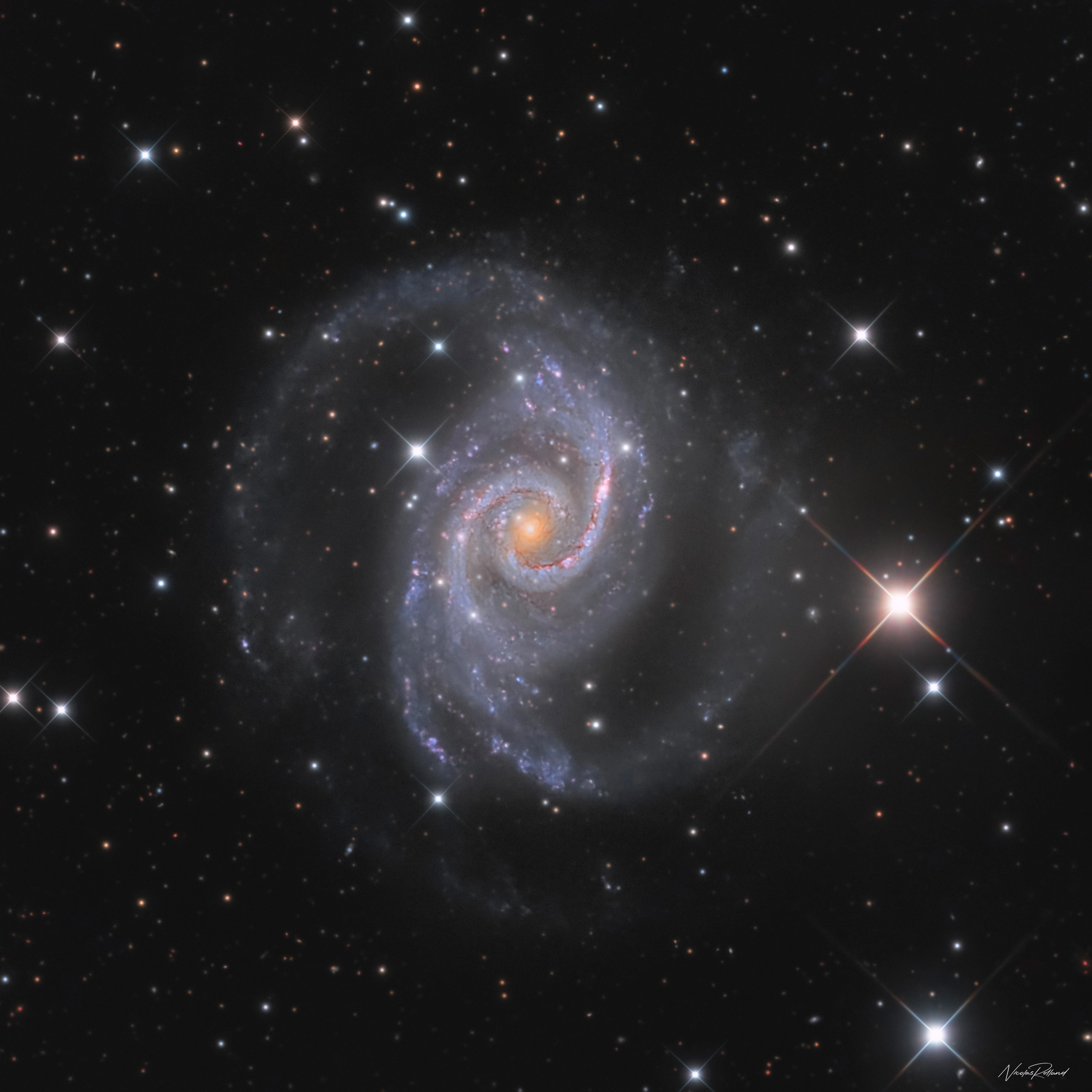
NGC 1566, the Spanish Dancer Galaxy, a grand-design spiral with flowing arms in Dorado, in 28 hours of LRGB

Processed by Nicolas Rolland, Paris. 28 hours gathered at El Sauce Observatory, Rio Hurtado, Chile.

Located about 40 million light-years away in the constellation Dorado, NGC 1566 is also known as the "Spanish Dancer Galaxy." This poetic nickname perfectly illustrates the grace of its spiral arms, whose elegant curves evoke the fluid movements of a captivating dance.

Classified among the grand-design spirals, NGC 1566 stands out with two luminous arms, dotted with sparkling blue star clusters and dark trails of cosmic dust. Its particularly bright and active core makes it one of the closest and most brilliant Seyfert galaxies, likely harboring a supermassive black hole that disrupts the very fabric of the surrounding galaxy.

NGC 1566 has also been the scene of spectacular phenomena, such as the observation of two recent supernovae. The first, discovered in 2010, was a type Iax supernova, followed in 2021 by a type Ia supernova, particularly bright with a magnitude of 12.
This image has been selected by Telescope Live March 1, 2025

Version française
Située à environ 40 millions d'années-lumière dans la constellation de la Dorade, NGC 1566 est aussi appelée la "galaxie de la Danseuse Espagnole". Ce surnom poétique illustre parfaitement la grâce de ses bras spiraux, dont les courbes élégantes rappellent les mouvements fluides d'une danse captivante.

Classée parmi les spirales de grand style, NGC 1566 se distingue par deux bras lumineux, parsemés d’amas d’étoiles bleues étincelantes et de sombres traînées de poussière cosmique. Son noyau, particulièrement brillant et actif, en fait l’une des galaxies de Seyfert les plus proches et les plus éclatantes, abritant vraisemblablement un trou noir supermassif qui perturbe l’étoffe même de la galaxie environnante.

NGC 1566 a également été le théâtre de phénomènes spectaculaires, comme l’observation de deux supernovas récentes. La première, découverte en 2010, était une supernova de type Iax, suivie en 2021 par une supernova de type Ia, particulièrement brillante avec une magnitude de 12.

Technical data
OpticsPlanewave CDK24 @ F/6.5
CameraFLI PL 9000
MountMathis MI-1000/1250 with absolute encoders
FiltersL, R, G, B
LocationEl Sauce Observatory, Rio Hurtado, Chile
DateMarch 2021 & October 2022
Exposures28 hours L 42x 600 sec, R 42 x 600 sec, G 42 x 600 sec, B 42 x 600 sec
Distance~69 million ly
SoftwarePixinsight, Photoshop
CopyrightsNicolas Rolland & Telescope.Live
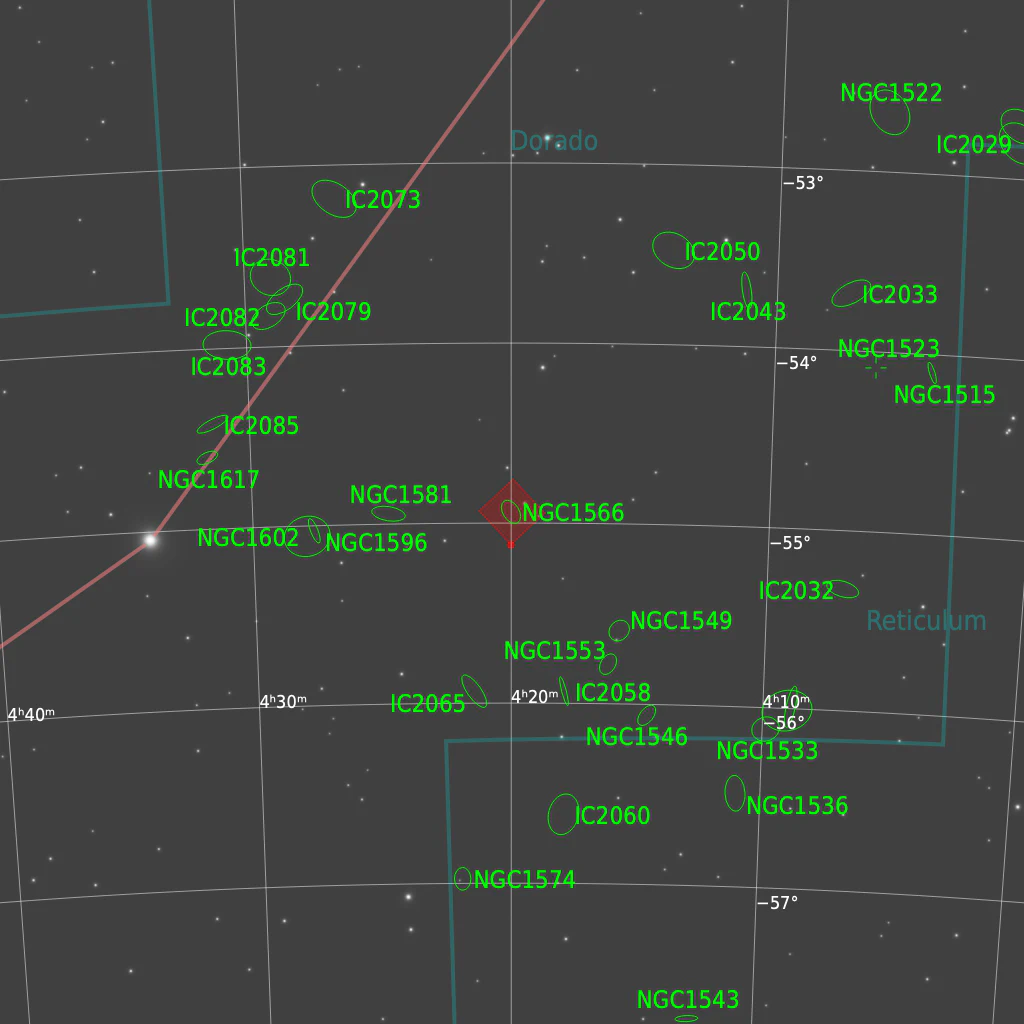
Finding chart spanish-dancer-galaxy-lrgb-close-up-chart
RA04h 19m 58.1s Dec-54° 56' 18.1" Size15.5 x 15.5 arcmin OrientationUp is 317 degrees E of N ConstellationDorado